A boat deck takes more punishment than almost any surface EVA foam ends up on. Sun all day, salt water, wet feet, fuel splashes, and people standing on it barefoot for hours. Get the spec wrong and the pad peels, fades, or soaks up water within a season. Get it right and it stays put for years.
Most of the failures we hear about come down to the same thing: the buyer ordered a generic foam sheet and hoped it would hold up at sea. Marine decking is a specific job. Run through these six checks before you place the order, and you will avoid most of the expensive lessons.
1. Closed-cell, no exceptions
This is the one that matters most. Open-cell foam is full of connected air pockets, and on a boat those pockets fill with water. The pad gets heavy, stays damp, and starts to smell. Closed-cell foam is different: each cell is sealed off from the next, so water stays on the surface instead of soaking in.
For decking, always order closed-cell EVA foam sheet. It is the same grade we supply for boats, kayaks, and ships, and it is waterproof by structure, not by a coating that wears off. If a supplier cannot tell you whether their sheet is closed-cell or open-cell, that is your answer — walk away.
2. Density and hardness: how firm it feels underfoot
Density decides whether the deck feels solid or spongy. Our EVA foam sheet runs from about 85 kg/m³ for soft, low-density grades up to 190 kg/m³ for high-density grades. For a deck that people walk on all day, the firmer end of that range holds up better: it resists heel dents, keeps its shape under coolers and tackle boxes, and does not compress flat after a season.
Hardness is the other half of the feel. Our sheet runs 15–80 Shore C overall — softer feels nicer barefoot, firmer lasts longer under traffic. If you cannot decide, ask about dual-density construction — a firm base layer with a softer top layer gives you both, and it is a standard option for deck pads.
3. Thickness: match it to the job
Thickness is not a case of “thicker is better.” A thin sheet, 2–5 mm, works for a flat overlay on an already sound deck. Go thicker, 6 mm and up, where people stand barefoot for long stretches, or where the deck underneath is uneven and needs cushioning. Our closed-cell sheets run 2–60 mm, and colorful grades go up to 90 mm. Thicker blocks are available too if you need a pad machined to shape rather than cut from sheet.
One practical point: the standard sheet size is 2000 × 1000 mm. A small kayak cockpit fits on one sheet; a full boat deck will not. Plan the layout before you order, so you know how many sheets you need and where the seams will fall.
4. Grip when wet
A deck pad that turns slippery when wet is worse than no pad at all. Bare EVA is already grippy, but for a working deck, order a textured surface — grooved, brushed, or diamond pattern. Texture is made to order, so say what you need when you send the inquiry.
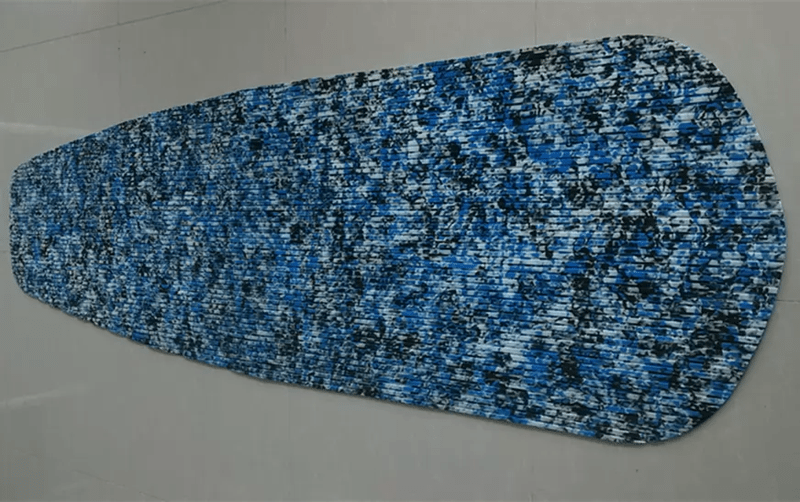
The pad in the photo above is a good example: a camo-patterned, grooved mat cut for a kayak cockpit. The pattern hides scuffs and fish blood, and the grooves channel water away instead of letting it pool underfoot. Plain black shows every mark; a two-tone or camo finish is the practical choice for a boat that actually gets used.
5. Sun and salt water
UV is what kills most deck foam, slowly. Our UV-resistant grades are made for outdoor use on boats, kayaks, and ships. Ask any supplier what UV testing their grade has actually been through — if they have no answer at all, their foam is probably an indoor grade.
Two things worth knowing. First, colors fade — light colors show it less, and a UV-resistant formulation slows it down. Second, dark colors get hot. A black deck pad in tropical sun can be uncomfortable barefoot by midday, so think about where the boat will spend its summers before you pick a color.
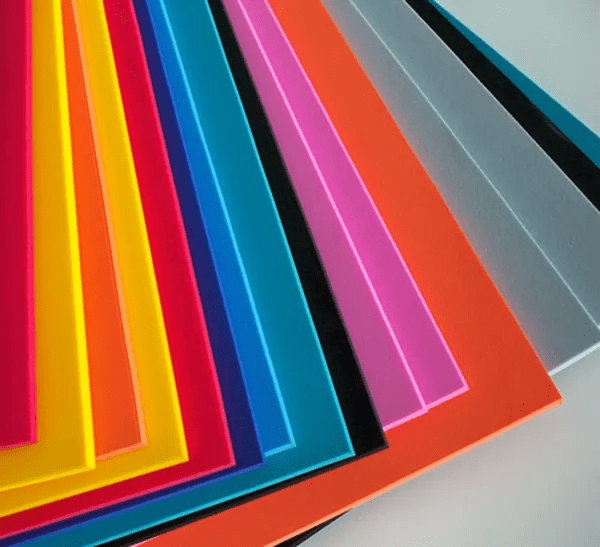
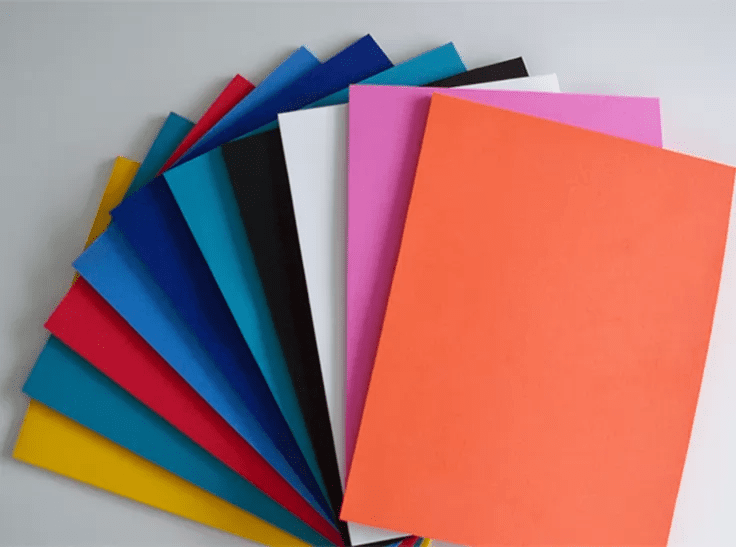
Salt water and fuel splashes are the easier part. Closed-cell EVA resists weather and chemicals, including splash contact with oils and fuels, and it does not absorb salt water. Rinse it with fresh water at the end of the day and it will look after itself. Our colorful EVA foam sheet range comes in 15 standard colors with Pantone matching, so you are not stuck with black or grey — just remember that the darker the color, the hotter it gets under a midday sun.
6. Fit: cut to shape, and how it stays down
A deck pad is only as good as its fit. Send us a drawing, a template, or the deck dimensions, and we die-cut the sheet to shape — including hatches, cleats, and curves. Ready-made marine pieces like sitting pads and back supports are also available; see our EVA kayak seat range for the shapes we already make for marine boats.
Before you finalize the order, settle the fixing method. Some buyers glue the pad down with marine adhesive, others want a self-adhesive backing applied at the factory. Ask about it in your inquiry rather than assuming it — the right answer depends on the deck material underneath, and it is much cheaper to sort out before cutting than after.
Ordering: sample first, then commit
Marine decking is one of those products where a sample settles every argument. We send samples within 7 days, so you can check the grip wet, the firmness underfoot, and the color in real sunlight before you commit to a full order. Our minimum order is 100 pcs per color, bulk production runs within 15 days, and the exact schedule is confirmed per order. Send your drawing and quantities and we quote within 24 hours.
Trade terms are FOB Ningbo/Shanghai, EXW, CIF, or CFR, and payment by T/T, L/C, D/A, D/P, or O/A. Our factory holds SGS, PAHS, and ISO 9001 certification, and REACH, RoHS, and EN71 testing can be arranged through SGS on request.
A deck pad is a small part of a boat, but it is the part your customers stand on. Spec it like it matters — closed-cell, the right density, a textured surface, and a UV-resistant grade — and it will outlast the season it was bought for.