A gasket is usually the cheapest part in the whole assembly — a few cents of foam cut into a ring — and it is the part that gets blamed when the product leaks. I have seen the same story more than once: a housing passes its bench test, ships, and starts weeping at the seam a month later. The bolts are tight. The lid is flat. The gasket just stopped doing its job.
Most of the time the problem is not the foam. It is the specification. The order said “EVA foam, 3 mm, black” and nothing else, so the supplier sent whatever was on the shelf. A gasket needs more than a thickness and a colour. This checklist covers the seven things worth deciding before you order, so the seal you get is the seal your housing needs.
What the gasket actually has to do
Strip it back and a gasket has one job: fill a gap and stay filled. It has to compress enough to take up the unevenness between two faces, push back hard enough to keep contact when the joint moves or vibrates, and keep doing that for the life of the product — not just on the day it leaves the factory. Everything on the checklist below serves one of those three things.
The checklist
1. Start with closed-cell, every time. An EVA gasket that has to seal needs closed-cell foam. In closed-cell foam every bubble is sealed off from its neighbours, so water and air cannot pass through the material itself. Open-cell foam is a network of connected bubbles — it breathes, it absorbs, and it leaks. It has its uses, but a seal is not one of them. If your order does not say “closed-cell”, say it now.
2. Match the density to the clamping force. Our closed-cell EVA foam sheet runs from 85 to 190 kg/m³, and that range exists because housings are not all clamped the same way. A light cover held by a few screws or a snap fit wants the softer end, around 85–120 kg/m³, so it can conform without much force. A bolted flange that clamps hard wants the denser end, 120–190 kg/m³, so the foam holds its shape instead of crushing flat and staying flat. Tell us how the joint is held together and we will suggest a density; guessing is how gaskets end up either too soft to seal or so firm they bow the lid.
3. State the hardness, not just the thickness. Thickness is the number everyone writes down. Hardness is the number that decides whether the seal works. Our sheet runs 15–80 Shore C, which is a wide range on purpose. Too soft and the gasket squeezes out of the joint the first time the bolts are torqued. Too hard and it never beds into the surface, so dust and water find a path around it. If you have a hardness that worked before, put it on the order. If you do not, describe the joint — bolt spacing, how flat the faces are — and we will pick a starting point for your sample.
4. Size the thickness for compression. Gaskets are cut from EVA foam sheet in 2–90 mm, but the thickness you order is not the thickness it works at. Plan for the gasket to compress by roughly a quarter once the joint is closed: a 4 mm gasket should end up working at about 3 mm. Too thin and it cannot take up the gap; too thick and the lid will not close properly, or the bolts bottom out before the seal is loaded. Measure the gap at its widest point, not its narrowest — the seal has to cover the worst of the joint, not the best of it.
5. Send a drawing, not a description. “About the size of a dinner plate” is not a specification. Gaskets are die-cut to your drawing, so send one: outside and inside dimensions, bolt-hole positions and diameters, and the tolerance you can live with. Ring gaskets, rectangular frames, gaskets with tabs or notches — all of it comes off the same cutting table, but only if the drawing says so. A DXF or a dimensioned PDF is enough. If you only have a sample of the old gasket, send that instead; we can measure from it.
6. Say what it will face. A gasket in a dry indoor cabinet and a gasket on outdoor equipment live different lives. EVA foam handles water, weather and dust well, and it resists splashes of oil and fuel. That covers most equipment housings, pump seals, junction boxes and enclosures. What it does not do is run hot — EVA is a general-purpose seal, not a high-temperature one. If your housing sits next to a motor or a heater, tell us the temperature before you order rather than after the first failure. The same goes for constant contact with solvents or fuels: a splash is fine, immersion is a different question.
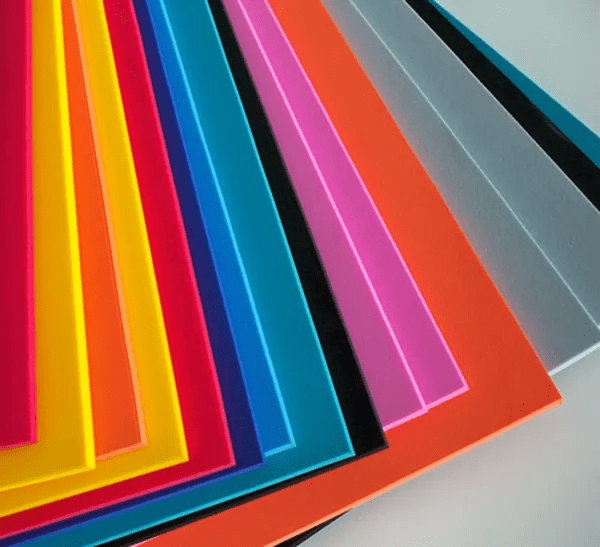
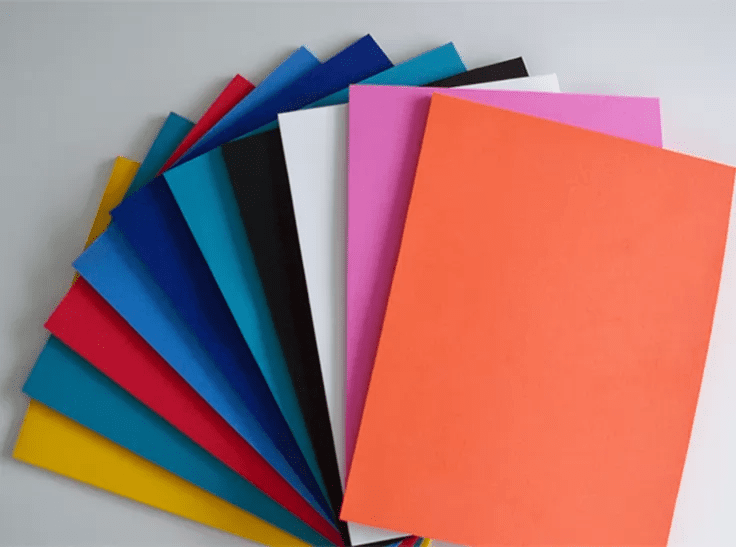
7. Decide the extras before you order. Two small decisions save a round of rework. First, adhesive backing: a peel-and-stick layer on one face holds the gasket in place during assembly and is worth having on any gasket that is fitted by hand. Second, colour: fifteen standard colours are kept in stock and any Pantone colour can be matched, which is handy if you colour-code different seals in the same product. Both are easier to add at the cutting stage than after the parts have shipped.
Three mistakes that keep showing up
Ordering by thickness alone. “3 mm black EVA” is not a specification. Two sheets at 3 mm can differ in density and hardness by a factor of two, and they will seal completely differently. Thickness, density and hardness are a set — send all three.
Copying a sample spec to a different housing. A gasket that sealed a small plastic cover will not necessarily seal a larger metal flange. The clamping force, the gap, the bolt spacing — all of it changes the answer. Treat each housing as its own order, even when the gasket looks similar.
Forgetting that foam relaxes. Every foam takes some permanent set if it is held compressed. Before you approve a bulk order, take the sample, clamp it in the real housing, and leave it for a day. Then open the joint and measure. If the gasket has lost most of its thickness and does not spring back, the density or hardness is wrong for that joint — better to find out on one sample than on a thousand parts.
What to send for a quote
A short enquiry with these five lines gets you an accurate quote within 24 hours and a sample within 7 days: your drawing or sample, the density and hardness you want (or a description of the joint), the thickness, the quantity, and anything extra such as adhesive backing or a colour. Our minimum order is 100 pieces per colour, and bulk production runs within 15 days of sample approval, with the exact schedule depending on the order. Standard trade terms are FOB Ningbo or Shanghai, EXW, CIF and CFR, with payment by T/T, L/C, D/A, D/P or O/A. The factory holds SGS and PAHS certification and ISO 9001, and passed a BV factory audit (record MIC-ASR2431136). REACH, RoHS and EN71 testing is available as an SGS special test on request.
A gasket is a small part, but it is the part standing between your product and the weather. Spend ten minutes on the specification and the seal stops being the thing that fails first.