A first-time buyer of interlocking EVA tiles usually starts with price. The expensive mistakes show up later: tiles that dent under a squat rack, edges that lift after a month, colours that fade beside a window, a bulk shipment that doesn’t match the sample. None of that is about price. It is about seven questions that take ten minutes to ask and save a container’s worth of trouble.
1. What will the floor actually carry?
A tile that works in a children’s playroom can fail in a gym, and a gym tile is overkill for a workshop walkway. Start with the load, not the catalogue.
For play areas and home gyms, the common retail tile is 60 × 60 cm at 10 mm thick — thick enough to cushion a fall, thin enough to stay stable underfoot. For heavy equipment, go thicker: our floor protection sheets run from 1.5 mm up to 25 mm, and the thicker end is what workshops use under benches and tool rooms. For a baby room or a martial-arts tatami area, the priority flips to a softer landing and a surface that stays put when someone rolls on it. Tell your supplier the end use first. A supplier who quotes without asking is guessing.
2. Is it closed-cell or open-cell?
This is the question that decides whether your tiles survive a wet mop. A closed-cell EVA foam sheet barely absorbs water at all, which is why it works outdoors, in gyms where people sweat on it, and anywhere the floor gets washed. Open-cell foam drinks water in, stays damp, and starts to smell — fine for a cushion insert, wrong for a floor.
Our EVA floor mat range is closed-cell throughout: negligible water or vapour absorption, washable with water, rot-proof and resistant to micro-organisms. If a supplier can’t tell you the cell structure in one sentence, that is your answer.
3. How thick — and how dense?
Thickness and density do different jobs. Thickness sets the cushion. Density sets how firm the tile feels and how well it springs back after being stood on all day. A thick, low-density tile feels soft at first and then goes flat where feet always land. A dense tile holds its shape.
As a reference point, our closed-cell EVA foam sheet runs 2–60 mm thick at 50–100 kg/m³, with a hardness of 20–40 Shore C. For floor tiles, the practical read is simple: ask for the density in kg/m³ and the Shore C hardness on the quote, then compare suppliers on the same numbers. Two quotes for “10 mm EVA tile” can hide a 30 kg/m³ difference, and that difference is the whole product. Always confirm the numbers on the sample, not just on the datasheet.
4. What size tile — and does the interlock actually hold?
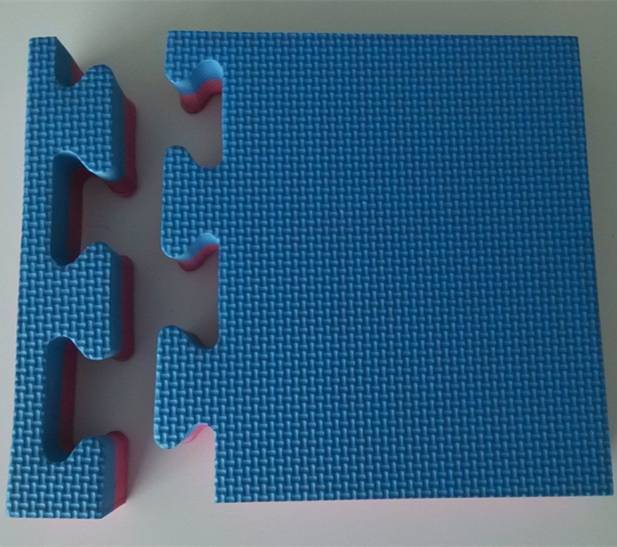
Most interlocking tiles are cut to slot together, but not every cut locks the same way. A loose joint creeps apart under foot traffic; a tight joint is a fight to lay and a fight to lift for cleaning. Ask for a sample of four tiles, click them together on a hard floor, and walk on the seam. Then pull one tile out and put it back. That two-minute test tells you more than a brochure.
Standard sheet size from our factory is 1000 × 2000 mm, cut to your tile size, and custom sizes are available on request. If you need border edging pieces — straight edges for the outside of the laid area — say so in the first inquiry, not after production starts. Edging is cut from the same run; ordering it later means a second run and a colour that may not match.
5. Will the colour survive sunlight?
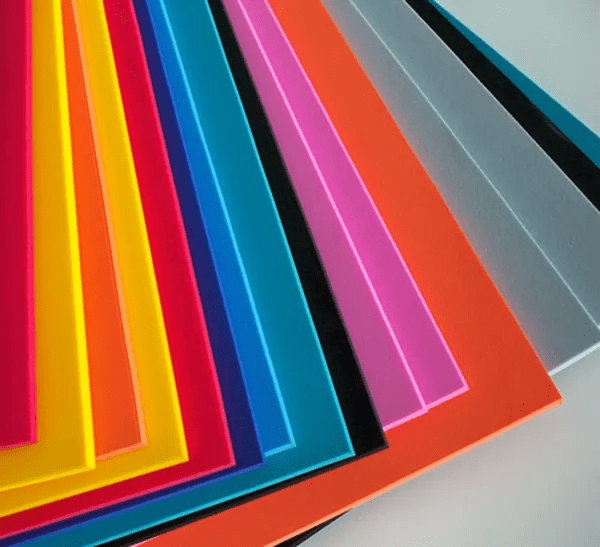
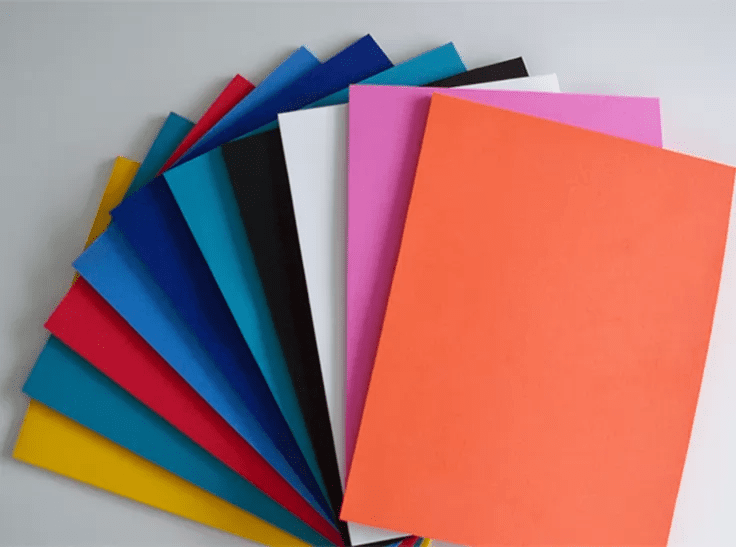
Black is the standard colour for a reason: it hides scuffs and it doesn’t fade. Custom colours are available, and single-colour tatami in muted tones is a steady seller, but bright colours beside a sunny window are where cheap foam shows itself. Our floor sheets are UV-resistant, so exposure to sunlight is fine, but that is a property of the material, not a promise about every pigment. If your tiles will sit in direct sun, ask for the colourfastness of that exact colour — and check the sample in daylight, not under warehouse fluorescents.
6. What about safety, smell, and the test report?
Floor tiles end up under bare feet and small children, so this question matters more than it does for a packing insert. We hold SGS and PAHS certification and ISO 9001, and REACH, RoHS and EN71 testing is available as an SGS special test per customer request — ask for the test that matches your market, not a generic certificate from another product line.
Two practical checks: open the sample bag and smell it. A strong chemical smell that doesn’t fade in a day is a warning, not a quirk. And ask which test report covers the exact density and colour you are ordering. A report for a different grade is not a report for yours.
7. How does the order actually run?
Know the mechanics before you commit. Our terms are straightforward: minimum order 100 pieces per colour, samples within 7 days, bulk orders within 15 days, exact schedule confirmed per order, and a quote within 24 hours of your inquiry. Trade terms are FOB Ningbo or Shanghai, EXW, CIF or CFR, and payment by T/T, L/C, D/A, D/P or O/A.
Packing is plastic bags and cartons, or as you request — say how you want tiles bundled (per tile, in sets of four, or by colour) before the quote, because repacking after production costs time. And keep one thing in mind: the sample is your contract. Check the joint, the smell, the dent test, and the colour in daylight before you approve bulk. A supplier who rushes you past the sample stage is telling you something.
The short version
If you only remember three things: closed-cell for anything that gets wet or washed, density and hardness on the quote — not just thickness — and a four-tile sample tested on a real floor before you approve bulk. Get those right and the rest of the order is routine.
We make interlocking floor mats, tatami tiles, anti-fatigue mats, floor protection sheets and EVA yoga mat in custom sizes, thicknesses from 1.5 to 25 mm, and custom colours, with a minimum order of 100 pieces per colour. Send us the room, the load, and the tile size you have in mind, and we will quote within 24 hours.