Ask three suppliers for a quote on “EVA foam sheet” and you may get three different materials back. One ships a dense, smooth sheet that shrugs off water. Another sends a soft, springy sheet that drinks it up. Both are EVA foam. The difference is the cell structure — and it decides whether your product works or fails in the field.
Most buyers never specify it. They write down thickness and colour, agree a price, and only find out months later, when a gasket leaks or a mat goes soggy, that they ordered the wrong kind. This guide explains the difference in plain terms, so your next order says exactly what you need.
The one-minute version
Closed-cell EVA foam is made of tiny sealed bubbles. Water, air and dust cannot pass through, so the sheet stays dry, firm and buoyant. Open-cell EVA foam is made of connected bubbles, like a sponge. Air and moisture move through it freely, so it feels softer, breathes, and absorbs sound — but it also absorbs water.
If your product lives outdoors, touches water, seals against something, or needs to hold its shape under load, you almost certainly want closed-cell. If it needs to breathe, cushion gently against skin, or soak up sound, open-cell is worth a look. When in doubt, order closed-cell. It is the safer default for most industrial and consumer products, and it is what the large majority of our export orders use.
What closed-cell actually means
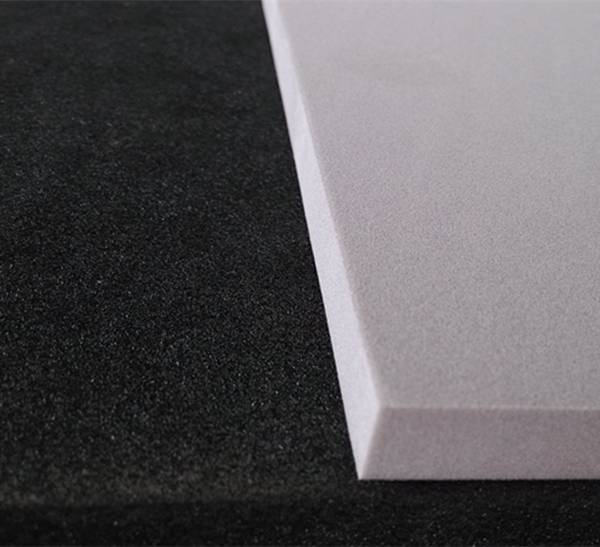
In closed-cell foam, each bubble is sealed off from its neighbours. Cut a sheet open and the surface looks smooth and even, almost like solid rubber. Press it and it springs back. Leave it in the rain and it comes out dry.
That structure is why closed-cell EVA shows up everywhere: die-cut packaging inserts that protect electronics in transit, marine decking and kayak seat pads that sit in spray all day, gaskets and seals, interlocking floor mats, yoga mats, cosplay armour that gets heat-shaped and painted, and orthopedic insoles that need to keep their shape under body weight. It is also easy to work with — it cuts cleanly, laminates well, takes adhesive backing, and heat-forms at around 110–140°C for shaped parts.
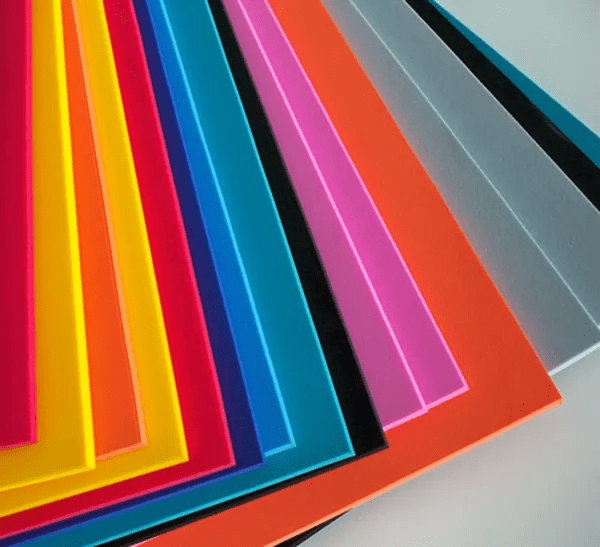
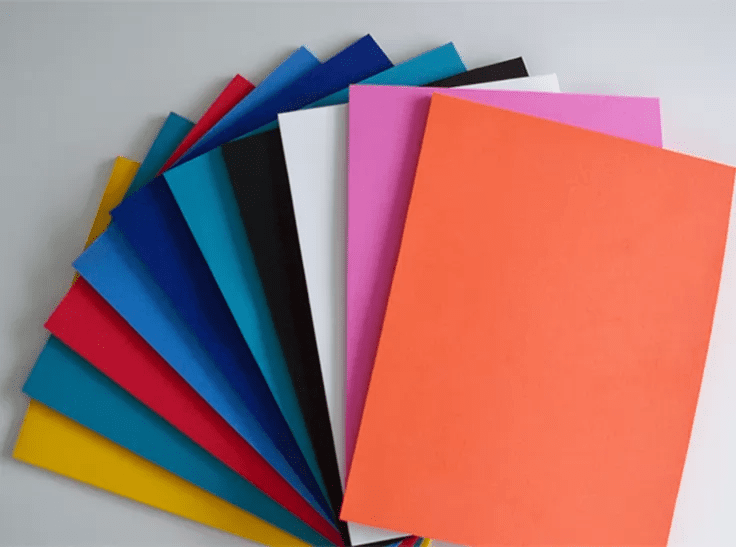
Our closed-cell EVA sheet runs 85–190 kg/m³ in density, 2–90 mm thick, 15–80 Shore C in hardness, in standard sheets of 2000 × 1000 mm cut to your size. Fifteen standard colours are kept in stock, and any Pantone colour can be matched on order.
What open-cell actually means
Open-cell foam is the opposite construction: the bubble walls are broken, so the cells connect into a network. Squeeze it and air escapes; release it and air flows back in. The surface feels softer and more textile-like, and the foam is lighter for the same thickness.
That makes open-cell the better pick in a narrower set of jobs: soft padding that sits against skin, acoustic panels and sound insulation where you want the foam to swallow noise rather than bounce it back, and cushioning layers inside a product where breathability matters more than water resistance. It also compresses further under the same force, which suits low-pressure padding.
The trade-off is real. Open-cell foam absorbs water, so it is the wrong choice for anything outdoors, anything that gets washed often, or anything that has to seal. It also recovers more slowly after deep compression, and it is harder to wipe clean. If your product will see rain, sweat, cleaning, or standing water, cross open-cell off the list.
Side by side
Closed-cell EVA: Water — barely absorbs any, stays dry. Feel — firm, smooth, springs back fast. Outdoor use — yes, marine, mats, packaging. Sealing — good, gaskets, pads, weather strips. Sound absorption — modest. Cleaning — wipe clean. Typical uses — packaging inserts, decking, gaskets, yoga and floor mats, cosplay, insoles.
Open-cell EVA: Water — absorbs water like a sponge. Feel — softer, breathes, compresses further. Outdoor use — no, soaks up rain and humidity. Sealing — poor, air and water pass through. Sound absorption — better, the open network traps sound. Cleaning — harder to dry out once wet. Typical uses — soft padding, acoustic lining, breathable cushioning.
Four orders, four answers
A buyer needs die-cut inserts for export packaging. The inserts protect machined parts on a sea shipment. Closed-cell, no question. The container may sweat, the port may rain, and an insert that absorbs moisture is worse than no insert at all. Density around 85–120 kg/m³ gives a good balance of cushioning and cost for most parts; heavier or sharper items go denser.
A buyer needs decking for a boat. Closed-cell again, and this time for a second reason: buoyancy and grip underfoot when wet. Open-cell decking would waterlog, go heavy, and grow mould. This is one of those cases where the wrong choice is not a quality complaint — it is a product that stops working.
A buyer needs soft padding inside a medical brace. Here open-cell earns its place. The padding sits against skin for hours, so breathability and a gentle hand matter more than water resistance, and the brace itself keeps the weather out. A common build is a closed-cell support layer laminated to an open-cell comfort layer — the two structures doing different jobs in one part.
A buyer needs a gasket for an equipment housing. Closed-cell. A gasket that lets air and water through is not a gasket. Specify the hardness as well as the thickness — 15–80 Shore C is a wide range, and a gasket that is too soft will squeeze out of the joint, while one that is too hard will not seal at all.
What to write in your order
Suppliers cannot guess your application. A short, specific enquiry gets you an accurate quote within 24 hours and a sample within 7 days. Include these six lines:
- Cell structure — closed-cell or open-cell.
- Density — for example, 100 kg/m³; if you are unsure, describe the load and we will suggest one.
- Thickness and hardness — for example, 10 mm at 38 Shore C.
- Sheet size or finished dimensions — standard sheets are 2000 × 1000 mm; die-cut parts come to your drawing.
- Colour — one of the 15 standard colours, or a Pantone reference.
- Anything extra — adhesive backing, lamination, printing, and whether you need SGS test reports. REACH, RoHS and EN71 testing is available as an SGS special test on request.
Two more numbers to keep in mind. Our minimum order is 100 pieces per colour, and bulk production runs within 15 days of sample approval — the exact schedule depends on the order. Standard trade terms are FOB Ningbo or Shanghai, EXW, CIF and CFR, with payment by T/T, L/C, D/A, D/P or O/A. The factory holds SGS and PAHS certification and ISO 9001, and passed a BV factory audit (record MIC-ASR2431136).
The test that settles it
Still not sure which structure you need? There is a simple check you can run on any sample. Put a drop of water on the surface and watch it for a minute. On closed-cell foam it sits there as a bead. On open-cell foam it disappears into the material. Then press the sample hard between your palms and let go: closed-cell bounces back at once, open-cell takes a beat longer.
Ask us for a sample of each — samples leave within 7 days — run those two checks against your real use, and the right structure usually picks itself. Getting this one decision right at the start is cheaper than re-cutting a mould, re-printing packaging, or explaining to your customer why the product they bought does not do what it was supposed to do.